-

-
-
Loading
Loading

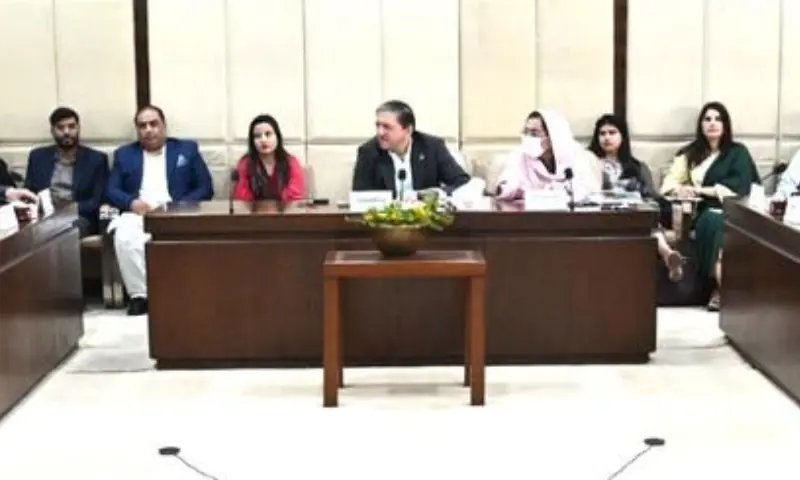

• Aurangzeb tells lawmakers he is engaged with IMF, friendly partners on reforms
• Defends banking restrictions to avoid FATF grey list risk
ISLAMABAD: As senators bemoaned ‘surveillance’ of parliamentarians and their families and dependents in the garb of regulations, Finance Minister Muhammad Aurangzeb said the International Monetary Fund (IMF) had appreciated Pakistan’s macroeconomic performance and would continue discussions on the impact of prolonged Middle East conflict on inflation, revenues and current account.
Testifying before the Senate Standing Committee on Finance, presided over by Saleem Mandviwalla, the finance minister said the IMF review mission had appreciated Pakistan’s initiatives up to February and agreed to discuss the impact of the Gulf crisis if it prolongs.
The two sides would also review external finance, inflation, revenue, and the current account position in light of regional development, as well as trends in the balance of payments and remittances. He said Pakistan had hard-earned macroeconomic stability and would protect it and build upon it. He said the government was also engaged with friendly partners in this regard.
He said the supply of LNG had stopped, and a $25 million cargo had risen to over $100m at present after Qatar declared a force majeure. He said the oil situation was rapidly fluctuating and the government was proactively taking stock of the situation on a daily basis under the Prime Minister’s directives and under the aegis of the Cabinet Committee on Petroleum Pricing.
Commenting on senators’ concern over tight restrictions on opening of banking accounts of the senators and their families, the finance minister said the country would have to comply with regulations of the global financial institutions; otherwise, he warned Pakistan would fall again into the grey list of the Financial Action Task Force (FATF), which it graduated after a lot of difficulties.
The committee discussed in detail the alleged misuse of Politically Exposed Persons (PEPs) regulations, which members said was leading to undue harassment of parliamentarians, judges, senior officials, and their associates. The Committee also reviewed the government’s contingency planning and preparedness measures to ensure supply stability amid the escalating conflict.
During deliberations on PEP regulations, members raised serious concerns that the current framework was creating unnecessary hurdles in routine banking and business activities. Senator Farooq H. Naek particularly questioned Regulation No. 5, which includes close associates and family members of parliamentarians, arguing that such provisions make it difficult for individuals to conduct normal financial transactions or even open bank accounts.
SBP Deputy Governor Anayat Hussain informed the committee that the instructions were issued in line with the requirements of the Financial Action Task Force (FATF). However, the Committee noted that the broad and general nature of these instructions could create an environment detrimental to business activity.
Members also questioned the authority of the State Bank of Pakistan to issue directives that could effectively override legislation passed by the parliament. The committee emphasised that FATF regulations are primarily intended to combat terrorist financing and should not create unnecessary obstacles for legitimate businesses.
To address the issue, the chairman directed the constitution of a sub-committee to identify regulatory and operational gaps and propose solutions in consultation with all stakeholders, including scheduled banks. He stressed that regulatory frameworks must not be misused and that no individual should face undue hardship in the name of compliance.
Published in Dawn, March 13th, 2026
if you want to get more information about this news then click on below link
More Detail