-

-
-
Loading
Loading

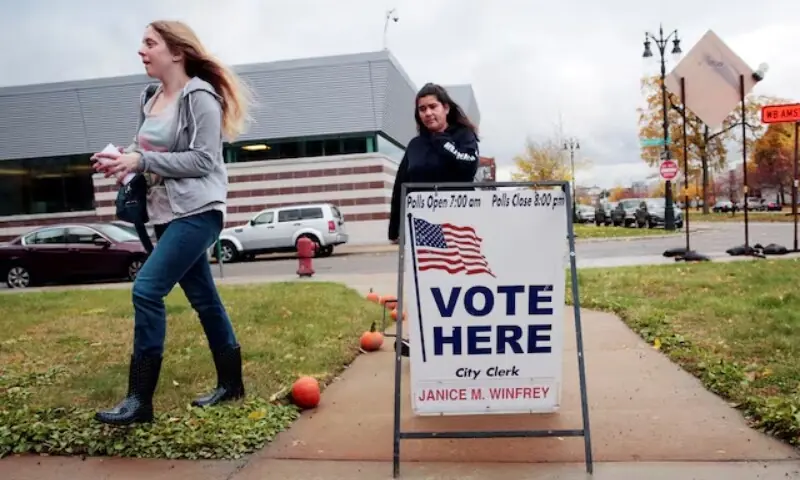

• National polls show they have modest edge over Republicans
• Congress serves as check on presidential powers
WASHINGTON: National polling suggests that Democrats hold a modest advantage over Republicans ahead of the 2026 US mid-term elections, a contest that could significantly affect President Donald Trump’s ability to advance his agenda during the second half of his term.
A compilation of recent generic congressional ballot surveys, published by The New York Times on Sunday, shows Democrats leading in most national polls by margins ranging from one to six percentage points, with one survey showing a larger Democratic advantage. The generic ballot asks voters which party they would support for Congress without naming specific candidates.
According to the non-partisan US Vote Foundation, a mid-term election takes place halfway through a president’s four-year term. In 2026, voters will elect all 435 members of the US House of Representatives and 35 members of the 100-seat Senate.
“The composition of Congress, and which party in Congress has greater power to make laws and decide whether to support, modify or reject the president’s actions, will greatly affect the president and the success of his administration,” the foundation noted.
Powerful check
Congress forms the legislative branch of the US government and serves as a powerful check on presidential authority. A Congress controlled by the opposition party can block legislation, launch investigations and make it more difficult for a president to implement policies.
Historically, mid-term elections have often been difficult for sitting presidents. The US Vote Foundation noted that “voters typically want change and therefore, the president’s party typically loses ground in mid-term House elections”.
According to the organisation, this occurred in 20 of the past 22 mid-term elections.
Current polling may reflect that historical pattern. President Trump’s job approval ratings remain weak by historical standards. The New York Times polling average shows 38 per cent approval and 58pc disapproval, while the Economist/YouGov average places his approval rating at 35pc and disapproval at 60pc.
Political scientists have long observed a strong relationship between presidential popularity and mid-term election outcomes. The 2026 elections are also unfolding amid an increasingly heated debate over the health of American democracy. Analysts say that public reaction to the administration’s domestic and foreign policies, including the consequences of the conflict with Iran, could influence voter sentiment and shape electoral choices.
The Washington Post recently reported that the Trump administration had pursued several controversial measures, including efforts to redraw congressional districts in some states, changes to voting procedures, and prosecutions of political opponents.
Fair electoral maps
Among the groups expressing concern is the Campaign Legal Centre (CLC), a Washington-based non-profit organisation that advocates voting rights and fair electoral maps. “Our democracy is under threat,” the CLC warned. “By protecting the freedom to vote and fighting for fair maps and transparent elections, we can ensure that our democratic system remains resilient. The future of our elections depends on the actions we take today.”
Another factor shaping the battle for control of the House is the congressional map that will be used in the 2026 elections. Because House seats are awarded district by district rather than according to the national popular vote, district boundaries can influence which party wins a majority even when national vote totals remain close.
As a result, Democrats leading in national polling do not automatically translate into a House majority.
Analysts note that control of the chamber will likely be decided in a relatively small number of competitive districts, where local issues, candidate quality and voter turnout often matter as much as national political trends.
With less than five months before elections, the political landscape could still shift significantly. Economic conditions, international crises, presidential approval ratings and voter turnout will all influence the final outcome.
For now, however, the early indicators point to a familiar pattern in American politics: an unpopular president, an energised opposition party and a mid-term election that could reshape the balance of power in Washington.
Published in Dawn, June 8th, 2026
if you want to get more information about this news then click on below link
More Detail