-

-
-
Loading
Loading


• Govt targets water storage, health, education uplift
• Population projected to reach up to 390m by 2050; GST exemption planned on contraceptives
ISLAMABAD: The government has continued its 5Es framework in the Annual Plan 2026-27, released on Friday, with emphasis not only on public investment to improve the macroeconomic framework but also on social sector uplift through better access to health and education, as well as improved water storage across the country.
The five Es are exports, e-Pakistan, environment, energy and equity, ethics and empowerment. Special focus is visible on population management and conservation of water resources.
The government has estimated that the country’s population will reach between 372 million and 390m by 2050. Key planned interventions include GST exemption on contraceptives, promotion of indigenous contraceptive production and district-level population projections.
The plan includes operationalisation of the D4D Data Portal Phase-III with the integration of four provincial feeds and the launch of district-level population projections till 2050.
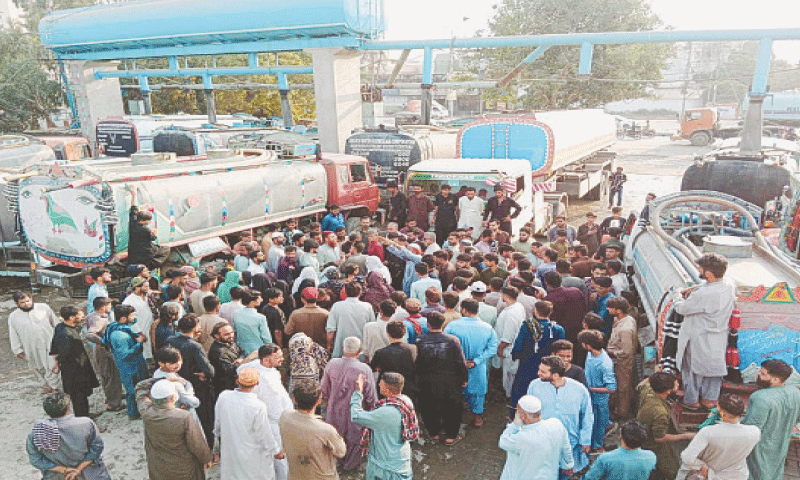
The Annual Plan has set a target to increase farmgate water availability from 63.5 million acre feet (MAF) to 84.2 MAF and enhance water storage capacity from 13.5 MAF to 23.5 MAF, apart from improving water-use efficiency from 40pc to 70pc.
There are 34 core water infrastructure projects involving large and medium storage dams, canals, flood mitigation, drainage and water accounting, amounting to Rs1.84tr, with an allocation of Rs97.35bn in the upcoming budget.
The federal PSDP allocation for this sector stands at Rs61bn, while provincial allocations include Rs165bn for Punjab, Rs117bn for Sindh, Rs23bn for KP and Rs31bn for Balochistan for urban infrastructure, water supply, sanitation and housing initiatives.
Key targets for the upcoming fiscal year include accelerated delivery of 150,000 affordable and climate-resilient housing units and increased access to water supply and sanitation coverage in urban areas across the country.
The plan seeks to integrate contraceptive and family planning services into routine healthcare delivery to improve contraceptive prevalence and reduce unmet need.
It also aims to scale up diabetes prevention and early detection initiatives through community outreach, awareness campaigns and preventive interventions.
The plan includes phased Hepatitis-C screening, PCR testing, treatment and EMR-based patient tracking under the prime minister’s flagship programme.
While Pakistan has implemented the National Multisectoral Nutrition Programme, the National ECD Policy Framework and the Benazir Nashonuma Programme, the target for FY27 is to improve integrated delivery through health, food, water and sanitation, social protection and school systems to enhance nutrition for families.
The “National Multisectoral Nutrition Programme to reduce stunting and other forms of malnutrition” will be implemented.
The plan also aims to strengthen policy and regulatory mechanisms to harmonise food laws and ensure food safety standards, along with institutionalisation of the Nutrition Framework with transparent resource allocation to increase the sustainable availability of safe food.
After ambitious awareness campaigns regarding transgender protection services and welfare support for federal government employees, the government plans to strengthen institutional resilience and scale up outreach to vulnerable groups.
Projects have been launched in the new budget to support human rights initiatives, senior citizen and child protection facilities, and inclusive education through the Autism Centre in Islamabad.
The government’s development initiatives in AJK, GB and the merged districts of KP, formerly Fata, are primarily focused on promoting inclusive and balanced development in the budget 2026-27.
In AJK, development efforts will focus on hydropower development, road connectivity and urban infrastructure improvement.
For the fiscal year 2026-27, development priorities will continue to emphasise energy, transport and communications, health, education, agriculture, digital transformation and institutional strengthening to advance inclusive growth and improve quality of life in these areas.
e-Pakistan, CPEC
The government has set ambitious targets for the e-Pakistan segment, including $7.3bn in IT and IT-enabled services exports, aligned with Uraan Pakistan’s exports pillar.
The National Artificial Intelligence Ecosystem Development Programme is a flagship $1bn initiative to accelerate the country’s technological transformation.
Other initiatives include operationalisation of the National Fiberisation Policy to accelerate fibre-to-the-home and backbone network expansion.
The government also plans full operationalisation of Cybersecurity for Digital Pakistan Phase-I, including screening and forensics laboratories, SOC/NOC integration and GRC delivery.
Besides this, a PSDP portfolio allocation of Rs30bn has been set for the next fiscal year, with a utilisation target of at least 80pc. The projects are consolidated under the Pakistan Digital Authority.
The key target under this head is to operationalise Gwadar Port and free zones in the upcoming fiscal year.
Published in Dawn, June 13th, 2026
if you want to get more information about this news then click on below link
More Detail