-

-
-
Loading
Loading

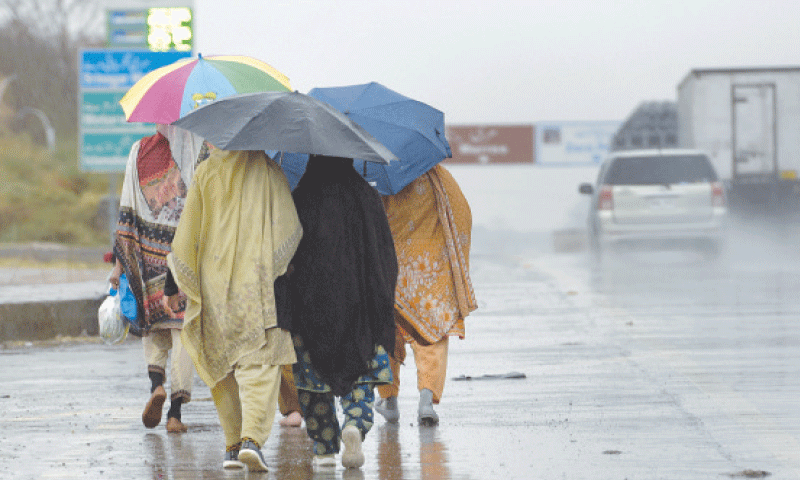

RAWALPINDI: Light to heavy rain lashed the twin cities of Rawalpindi and Islamabad as well as Murree on Monday, inundating low-lying areas in parts of the region.
The rain started at 5:50am and continued for an hour, bringing the temperature down to 34 degrees Celsius. Residents woke up to a cloudy morning and pleasant weather, but by afternoon the sun emerged and dominated the skies.
Light rain created a slushy mess in downtown areas, while heavy showers around Soan River along the main GT Road from Soan River to Rewat inundated the road leading towards DHA Phase-II.
Water also accumulated on Adiala Road, creating difficulties for commuters. Construction work in Ganjmandi and Saidpur Road areas further added to the muddy conditions.
Following the Pakistan Meteorological Department’s forecast of more rain and possible urban flooding till Wednesday, the district administration, Water and Sanitation Agency (Wasa), Civil Defence Department and Rescue 1122 remained on high alert to deal with any emergency.
The Meteorological Department recorded 106 millimetres (mm) of rainfall in Murree, 28mm at Saidpur, 22mm at Zero Point, 12mm at Golra in Islamabad, 1mm at Chaklala, Pirwadhai and Gawalmandi, 9mm at Kutchery and Shamsabad, and 8mm at New Kattarian in Rawalpindi.
A Met Office official said monsoon currents from the Arabian Sea and Bay of Bengal were penetrating the upper parts of the country and would continue till Wednesday. He said a westerly wave was also likely to affect upper and central parts of the country from Tuesday.
He said widespread intermittent rain, windstorms and thundershowers were expected in Khyber Pakhtunkhwa, Kashmir, Islamabad, Punjab, northeastern Balochistan and Gilgit-Baltistan. Heavy rainfall, at times very heavy, may also occur at a few places during the period.
Hot and very humid weather is expected over southern parts of the country.
The Met Office also issued an alert, warning that heavy rains may trigger landslides in vulnerable areas of upper Khyber Pakhtunkhwa, including Dir, Chitral, Swat, Kohistan, Buner, Mansehra and Abbottabad, as well as Gilgit-Baltistan, Murree, Galiyat and Kashmir.
It warned that heavy rains could cause flash flooding in local streams and nullahs of Kashmir, Murree and Galiyat, northeastern Punjab, Islamabad, Khyber Pakhtunkhwa, Gilgit-Baltistan, hill torrents of Dera Ghazi Khan and northeastern parts of Balochistan.
The department said urban flooding was possible in Islamabad, Rawalpindi, Peshawar, Gujranwala, Lahore, Sialkot, Multan and Faisalabad during the wet spell. It added that windstorms, lightning and heavy rains could damage weak structures, including solar panels, electric poles and billboards.
Wasa Managing Director Azizullah Khan said Monday’s rain did not increase the water level in Leh Nullah, with the level recorded at 5 feet at Kattarian Bridge and 4 feet at Gawalmandi.
However, he said a strong spell was expected on Tuesday and Wednesday, which could increase the water level in Leh Nullah, and arrangements had been made to deal with the situation.
He also said more rains were expected in July and the Rawal Dam was likely to fill in the coming days. He added that the water level in Khanpur Dam was also expected to rise.
Meanwhile, more than 106mm of rain was recorded in Murree during the last 24 hours. Continuous rainfall improved the weather, while the number of tourists visiting the hill station also increased. The district administration placed all relevant institutions on high alert to deal with any possible emergency.
Deputy Commissioner Murree Agha Zaheer Abbas Shirazi told Dawn that the district administration was continuously monitoring the rain situation and all relevant departments were active in the field.
“The staff of Rescue 1122, police, traffic police, municipal institutions, highways department and other institutions are performing their responsibilities to provide all possible facilities to citizens and tourists,” he said.
He said the situation was being monitored round the clock from the district control room, while sensitive locations, rain drains, highways and landslide-prone areas were being specially monitored for immediate action in case of any untoward incident.
Published in Dawn, July 21st, 2026
if you want to get more information about this news then click on below link
More Detail