-

-
-
Loading
Loading

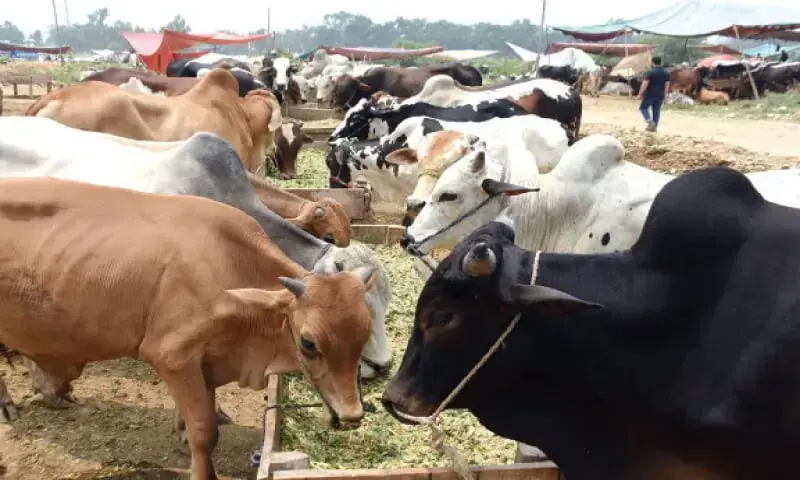

LAHORE: A feasibility study has revealed that cattle markets can emerge as a significant source of climate finance, as the manure generated across major markets can be converted into biogas, organic fertiliser, and internationally tradable carbon credits under a structured waste-to-energy programme.
The study was conducted by the Punjab Cattle Market Management and Development Company (PCMMDC), a subsidiary of the Punjab government’s local government and community department and had been presented to the company’s board of directors (BoDs).
The PCMMDC manages eight modern cattle markets among many others, which are also Punjab’s largest cattle markets. These include markets in Multan, Chichawatni, Arifwala, Sheikhupura, Shahpur Kanjran in Lahore, and Jhang. Together, these markets handle around 80,200 animals per week and generate roughly 87,130 kilograms of manure per day.
At present, much of this waste is left to decompose in the open, releasing methane, a greenhouse gas significantly more potent than carbon dioxide.
Feasibility study says manure generated across province’s major markets can be converted into biogas, organic fertiliser, and internationally tradable carbon credits
“The study concludes that, if scientifically captured and processed, this waste stream can become a viable environmental asset as well as a new source of revenue for the public sector,” commented a senior official of the company while talking to Dawn on Sunday.
According to the study, the recommended solution was installing horizontal plug-flow anaerobic digesters, which process cattle manure in sealed conditions to produce compressed biogas, organic fertiliser, and certified carbon credits. The study was conducted in three phases, beginning with carbon pre-feasibility, followed by technical site validation, and finally project design and financial structuring. This included field visits, manure collection verification, technology screening, carbon baseline analysis, and financial modelling for each site.
The findings showed that four of the eight modern cattle markets were technically and commercially viable for implementation in the near term. These are Multan, Chichawatni, Sheikhupura, and Arifwala. Among them, Multan and Chichawatni had been identified as the highest-priority sites for Phase 1 implementation on the basis of feedstock reliability, collection efficiency, land availability, supporting infrastructure, and lower execution risk.
At Multan, the study estimated that the market could generate about 72,561 carbon credits per year, alongside 8,357 cubic metres of biogas per month and more than 30,000 kilograms of organic fertiliser per month. Chichawatni presents even stronger potential, with an estimated 124,582 carbon credits per year and monthly biogas production of 15,200 cubic metres.
Over a five-year crediting period, this would amount to around two million verified carbon credits, which could fetch a good price, provided the Government of Pakistan also approved it for Article 6.2 Authorisation pathway.
An important feature of the proposed model is that all eligible sites would be registered under a single programme of activities under the gold standard. This would allow individual cattle markets to be added in phases as separate project activities, reducing transaction costs and simplifying the process of registration, monitoring, and verification. The study also maps a potential Article 6 authorisation pathway under Pakistan’s climate framework, which could further improve the strategic value of the programme.
The significance of the study extends beyond climate mitigation. If implemented, the project would improve waste management at major cattle markets, reduce local pollution and odour, create cleaner fuel alternatives to LPG, and produce organic fertiliser for agricultural use. It would also position Punjab as a first mover in converting municipal and livestock waste streams into climate-linked financial assets.
Overall, the study marks an important step for PCMMDC and the Government of Punjab as it explores new ways to improve the financial and environmental performance of Punjab’s public institutions. It also highlights a broader opportunity within public finance management: climate finance is no longer limited to forests, solar power, and large industrial projects. With the right technical structuring, even cattle market waste can become a source of sustainable revenue and a contributor to Pakistan’s low-carbon development pathway.
“The PCMMDC would now begin carbon credit issuance and registration process, which would involve subsequent phases of carbon credit project development, including local stakeholder consultations, preparation of project design documents, construction of biogas plants at the two viable sites and using the bio-gas for commercial and industrial off-take,” said the official.
To a question, the official said the company had been exploring an innovative initiative to convert cattle waste into clean energy and carbon credits, creating a new revenue stream while improving environmental conditions across Punjab.
Currently, according to him, the unmanaged cattle manure releases methane — a highly potent greenhouse gas — into the atmosphere. Under the proposed project, this waste would be processed through biogas plants, where methane was captured and utilised rather than released. The captured gas would be used to generate electricity for cattle market operations, reducing reliance on the national grid, and would also be upgraded into Bio-CNG for sale to industry and the transport sector as a substitute for imported fuels such as LPG and natural gas. In addition, part of the gas may be supplied as a clean cooking fuel to nearby vendors, while the remaining by-product would be converted into organic fertiliser for agricultural use.
Alongside energy generation, the project enables the creation of carbon credits, which represent verified reductions in greenhouse gas emissions. These credits can be registered under international standards and sold to global buyers, generating foreign exchange earnings without increasing user charges in cattle markets. Internationally, carbon credits are typically priced in the range of $5 to $15 per credit, with methane-based projects often fetching around $10 or more.
“Based on this, if cattle markets in Punjab generate approximately 200,000 carbon credits annually, the potential revenue could range between $1 million and $3 million per year (roughly PKR 280 million to 840 million). However, carbon income is considered a supplementary revenue stream, contributing around 10–25% of total project earnings, while the primary financial returns will come from the sale of energy and fertiliser products,” the official explained.
Published in Dawn, April 20th, 2026
if you want to get more information about this news then click on below link
More Detail