-

-
-
Loading
Loading

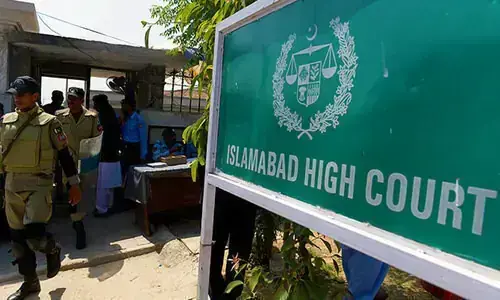

ISLAMABAD: A larger bench of the Islamabad High Court (IHC) reaffirmed in a detailed judgement on Monday that the chief justice was the sole “master of the roster”, ruling that a July 2025 order by Justice Sardar Ejaz Ishaq Khan in the Aafia Siddiqui case was recalled for being issued by a forum that was not “lawfully constituted”.
Last year in July, Justice Khan issued contempt notices to the prime minister and the entire federal cabinet over non-compliance with the court’s directions in a petition filed by Dr Fowzia Siddiqui seeking the release of her sister, Dr Aafia Siddiqui, from a US prison.
However, the registrar’s office did not execute the notices because the judge was not included in the duty roster approved by the chief justice.
Later, the court registrar’s report had recommended that a larger bench should address questions concerning the validity of the July 21 hearing.
The central issue identified was that Justice Khan’s bench was not authorised to hear cases on July 21. The weekly roster approved by the chief justice had not assigned him any bench duties that day, and the official summer vacation roster also listed him as being on leave.
On Monday, the matter was fixed before the larger bench, comprising Justices Arbab Muhammad Tahir, Raja Inaam Ameen Minhas, Khadim Hussain Soomro and Muhammad Azam Khan.
In the judgement, authored by Justice Minhas, stated that no bench could legally exercise jurisdiction unless constituted through a roster duly approved by the chief justice.
The bench observed that Justice Khan’s leave schedule had been publicly notified in advance, and in line with that schedule, his name was excluded from the weekly roster prepared by the deputy registrar (judicial) and approved by the IHC chief justice.
Despite this, the judge held court on July 21, 2025, heard cases, and issued directions, including those for the initiation of contempt proceedings against members of the federal government, the bench noted.
It observed that under the high court rules, the constitution of benches fell within the exclusive domain of the chief justice.
Moreover, the judgement recalled that in view of institutional and constitutional implications, the matter was referred to the IHC chief justice for the constitution of a larger bench to settle questions arising from the July 21 order.
The larger bench framed three key questions for determination: whether a bench existed in law merely because judges were present or only upon approval of the roster by the chief justice; whether a judge could self-assign or assume jurisdiction in a case; and whether the chief justice is legally obliged to obtain consent of a bench before consolidating identical petitions and reallocating them for hearing.
The bench examined Articles 175(2) and 202 of the Constitution in this regard, and noted that the former stated that no court shall exercise jurisdiction except as conferred by the Constitution or by or under law.
It held that jurisdiction was “not an abstract concept” attached to a “judge personally” but “flows from the lawful constitution of a bench in accordance with prescribed rules”.
The bench explained that while judicial power was vested in the high court, but exercising this power in a particular case required its “activation” through a lawfully constituted bench under the approved roster.
Merely the physical presence of judges in a courtroom did not create a bench in the eyes of law, the judgement said, adding that a bench came into “juridical existence” only when constituted by the chief justice through an approved roster or specific order.
It referred to chapter 10 of the High Court Rules and Orders, with the judges asserting that the constitution of benches is declared to be the “exclusive concern” of the chief justice.
The deputy registrar (judicial) may prepare a draft roster, but it would acquire legal force only upon approval by the chief justice, the judgement said. It declared that no judge or committee could independently constitute a bench or allocate judicial work.
To reach its conclusions in the judgement, the larger bench also relied on the Supreme Court’s precedents, including a decision in which it was held that benches could not self-constitute, self-select cases, or self-propagate proceedings.
The larger bench observed that permitting judges to sit and assume jurisdiction outside the approved roster would “undermine institutional discipline” and effectively make each judge the master of his own roster, a situation that it deemed would be incompatible with constitutional design.
On the question of self-assignment, the bench held that a judge could not take up or retain a case unless it had been lawfully assigned through the roster.
Any such assumption of authority amounted to exercising jurisdiction “without legal conferment and renders resulting orders void”, the judgement said.
Addressing the consolidation of cases, the bench ruled that the chief justice was not required to obtain consent of individual benches before withdrawing or consolidating identical or substantially similar petitions.
Consolidation, it held, was an institutional measure aimed at preventing conflicting judgements and ensuring coherence in the court’s jurisprudence.
Concluding its findings, the larger bench held that the proceedings conducted on July 21, 2025 in the Aafia Siddiqui case were undertaken by a forum that had not been “lawfully constituted” under the approved roster.
Consequently, it declared that the July 21 order was made without jurisdiction and recalled.
The judgment emphasised that adherence to the roster system was not a matter of administrative convenience but a constitutional requirement, designed to safeguard the rule of law and maintain orderly administration of justice within the high court.
if you want to get more information about this news then click on below link
More Detail