-

-
-
Loading
Loading

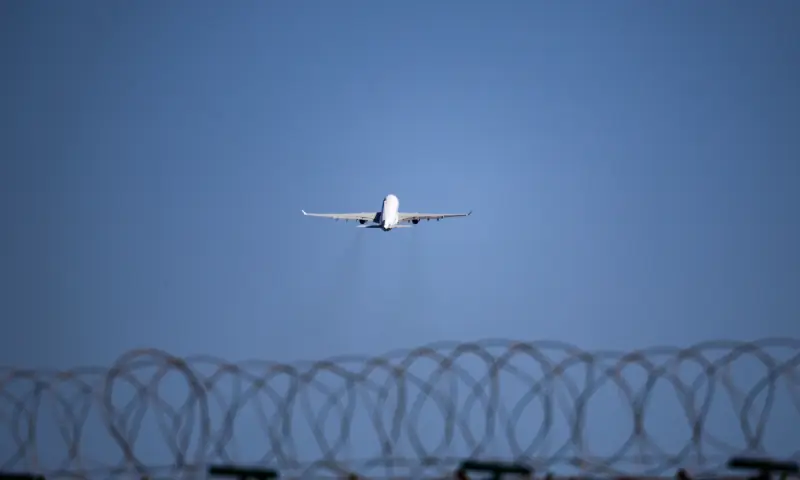

Airline pilots have faced escalating risks in recent years, from drone incursions to flight paths squeezed by conflict. Now, US-Israeli attacks on Iran are making the skies even more perilous and ratcheting up the pressure on those flying through them.
The outbreak of war in the Middle East has put hundreds of ballistic missiles and attack drones into the skies above some of the world’s busiest airports. Tehran’s retaliation against the United States and its allies has included hitting airports, grounding scores of flights from Dubai to Abu Dhabi. A trickle of rescue flights has made it through for thousands of stranded passengers.
Reuters spoke to eight pilots and more than a half-dozen aviation and security insiders who said the accumulation of conflicts — from Ukraine to Afghanistan and Israel — has increased the burden on pilots, forcing them to manage shrinking airspace and the wider use of military drones far from active war zones. That’s increased the strain on the mental health of pilots desperate to keep themselves and their passengers safe.
“We are not military pilots. We are not trained to deal with these kinds of threats in the air,” Tanja Harter, a pilot with Middle East experience and president of the European Cockpit Association, told Reuters.
The current crisis is the latest in a string of security threats the sector has faced over the years, she said, which could cause “fear and anxiety” for pilots. Airlines now often have peer programs to help, she said, adding as a pilot she would not want to “share airspace with missiles”.
Airspace safety has worsened in the last two-and-a-half years as conflicts have grown, industry experts said, through a combination of GPS spoofing — maliciously tricking planes about their position — and increased numbers of missiles and drones.
An Air France flight to bring stranded French nationals home from the United Arab Emirates turned back due to missile fire on Thursday. A Lufthansa pilot on Friday diverted from Riyadh to Cairo over regional security fears.
Middle East-trained pilots have become wearily used to emergencies, the head of Lebanon’s civil aviation body said. The escalating conflict put those skills to the test quickly. Video footage on March 5 showed planes taking off from Beirut airport as smoke billowed over buildings in the Lebanese capital.
“Middle East pilots have always faced crises, so from the start we trained how to deal with contingencies, emergencies and everything else,” said Captain Mohammed Aziz, director general of Lebanon’s civil aviation authority.
“No one can give you a guarantee that they won’t bomb the airport or will bomb the airport.”
One Middle East Airlines’ pilot with a decade of experience said routes to Beirut have become more complex. In the past, shoulder-fired anti-aircraft missiles in Lebanon usually had a range of 15,000 feet, so pilots would increase altitude to stay out of range, he said, while planes often carried extra fuel in case they were forced to divert.
Still, most missile strikes are far enough away not to be a risk and pilots are often too busy to worry about them.
“You’re actually busy enough on the plane trying to make sure you have clearance to land, that everything is in order, so you don’t have time to process your emotions over what’s happening outside the plane,” he said.
The risks are not confined to the Middle East. Since Russia’s 2022 invasion of Ukraine, drones have become a key weapon on both sides. Airports in European cities from Stockholm to Munich have faced drone disruptions — suspected though not confirmed to be linked to the conflict.
Airline Captain Christian von D’Ahe, a commercial aircraft pilot for 15 years and head of the Danish Air Line Pilots Association, is alarmed by the emerging threat.
“Drones are not easily detected,” Von D’Ahe said. “We can see them in the air, and they’re very small. So sooner or later, something will happen.”
Drones striking an aircraft’s engines could cause total power loss, while damage to wings could compromise a jet’s ability to manoeuvre.
Most registered planes emit a signal via a transponder, a device that identifies aircraft to radar, but drones do not, leaving pilots in the dark. Regular radars used by airports struggle to catch drones. Specialised radar exists, but is typically operated by law enforcement or the military.
Dedrone, a company that produces counter-drone technology, said there were over 1.2 million drone violations in the US in 2025, with more expected in coming years.
Airports can use radar, frequency sensors and jamming tools to counter drones, while some systems can “spoof” them off course. But safety concerns mean airports cannot shoot drones down.
Tim Friebe, an air traffic controller in Germany and a vice president at the Air Traffic Controllers European Unions Coordination (ATCEUC), said drones were a “threat that is growing”, while airports often had limited options.
“For now we have reports, pilot reports, or sometimes controllers spot drones. The problem is there’s not much you can do except shutting down the airport,” he said.
Drones shut down some of the world’s biggest airports from Munich to London’s Gatwick last year, driving operators to beef up their foreign object and drone detection systems, according to half a dozen industry officials.
Moritz Burger, a commercial pilot based in Germany, recalled spotting an object that looked like a balloon with a structure underneath as he was about to land at a European airport.
“I was looking out of the window and suddenly there appeared an object that passed by just below our aircraft. We could see it for maybe one, maximum two seconds,” he said, adding it startled him and left him no time to take any evasive action.
“When you encounter such a near-miss or some passing object, there is not enough time to react. So it is unrealistic to expect that pilots could fly around such an object. There’s pretty much nothing we can do.”
if you want to get more information about this news then click on below link
More Detail