-

-
-
Loading
Loading


I am writing this from a hospital waiting room where the wi-fi is aggressive, the coffee is optimistic, and my father is currently having his knee surgically improved against his will. The last part is not entirely accurate; he consented to the surgery.
It is the recuperation he is resisting, with the focused, creative energy of a man who has decided that the medical profession, for all its centuries of accumulated knowledge, has fundamentally misunderstood his particular knee.
He will not do the prescribed exercises at the prescribed intervals. He has opinions about his medication schedule that differ meaningfully from those of his surgical team. He listens to advice the way a very senior cat listens to instructions: with complete attention, apparent comprehension, and zero subsequent compliance. I have spent the better part of this week sitting across from him, deploying every rational argument available to a grown adult son, and achieving roughly nothing.
I am told this stubbornness is a family trait. I have been told this, specifically, by my father, which I find to be an extraordinary piece of self-awareness from a man who, 20 minutes ago, informed his physiotherapist that he knew a better way to do the exercise she had just demonstrated.
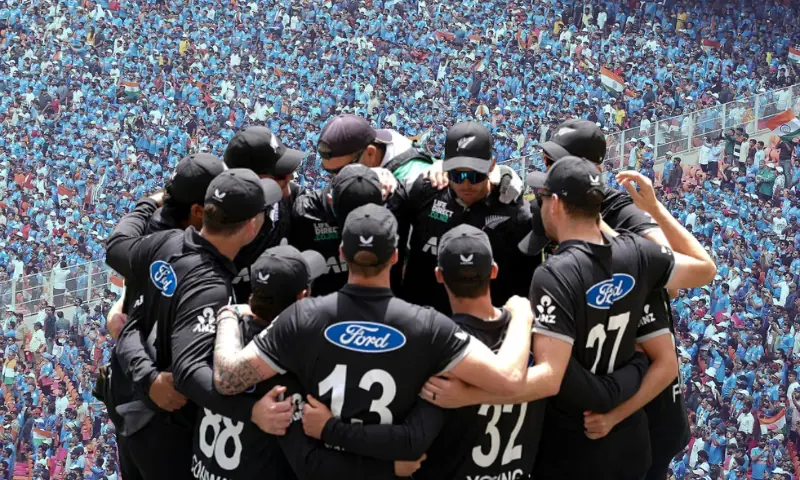
It is in this context, equal parts helplessness, admiration, and the vaguely surreal intimacy of a hospital waiting room, that I have been catching stolen glimpses of this T20 World Cup, specifically, of a team that has spent this entire tournament doing something my father would deeply respect: ignoring the script entirely, and winning anyway.
New Zealand, ladies and gentlemen.
Which brings me to Sunday. And to the argument swirling in my head.
You know what the Board of Control for Cricket in India actually trades in? Not cricket. Cricket is just the headliner. What the BCCI trades in, with a consistency that would make a Coca-Cola sales manager weep into his quarterly report, is the feeling that if you stop watching for even one afternoon, something irreplaceable will happen without you.
They didn’t invent that feeling. But somewhere in the 1990s, a group of communication mavens in Mumbai figured out how to bottle it, franchise it, and pipe it directly into the nervous system of 836 million people simultaneously. That’s not a board of cricket. That’s a pharmaceutical company. And the drug, the glorious, all-consuming, argument-starting, WhatsApp-forward-generating drug, is Indian cricket: administered 365 days a year, in 11 languages, at a volume that makes reasonable conversation impossible.
Every other cricket board in the world should study this. Not the politics. Not the money, though there is extraordinary money. Study the communication architecture: the decades of smart, obsessive, occasionally chaotic but always emotionally intelligent people who built a machine so effective that a nation of 1.5 billion looks up from whatever it is doing — farming, coding, running a chai stall, performing open-heart surgery, and thinks: but first, cricket.
That is genuinely the only thing worth saying about the BCCI today because Sunday belongs to someone else entirely.
Let’s talk about a number. 100,000. That is the approximate size of New Zealand’s entire active cricket-playing population. Adults, juniors, even the six-year-olds having a go on a Saturday morning while their parents drink flat whites on the sidelines, half-watching. All of them. 100,000.
Now consider the other number: 836 million. That is the count of Indians who, by every credible measure, treat cricket as a matter of personal and spiritual urgency. Run that ratio. Go ahead, we’ll wait.
Basically, you are looking at 8,360 Indian cricket obsessives for every single New Zealander who has ever picked up a bat. India doesn’t select a cricket team from a talent pool. Instead, it runs a civilisational shortlist, culled from a country where being the best 11 requires first defeating approximately 70 million people who also want the job.
And yet. And yet.
Finn Allen, a man from Auckland who grew up in a place where the first sporting question anyone asks is not if you watch cricket but if you watch the rugby, walks onto a World Cup semi-final pitch and hits the fastest century in the tournament’s history. Thirty-three balls. South Africa, one of the most intimidating bowling attacks on the planet, was reduced to spectators at their own elimination.
This is what New Zealand does. With 100,000 people, a cricket season that runs shy of even six months and then politely steps aside for the All Blacks, and a selection pool so small that your national opener probably knows your national spinner’s mother, they arrive at World Cup finals. They just show up, these 11 men from the end of the Earth, calm and slightly dangerous, like they never read the chapter on being underdogs.
Which is, I suppose, why I keep thinking about dad.
Oscar Wilde once observed that all women become their mothers. That, he said, is their tragedy. No man does. That, he said, is his.
Wilde, I think, never spent a week in a hospital waiting room watching his father explain physiotherapy to a physiotherapist. The stubbornness, it turns out, does not skip generations. It simply waits, quietly, for the right moment to announce itself, and then walks out to bat like it owns the crease.
Finn Allen would understand. So would Kane Williamson. So would every one of those 11 men who will walk out in Ahmedabad on Sunday and face a stadium that could seat the entirety of New Zealand’s active cricket-playing population and still have 32,000 empty seats looking for someone to fill them, in a country where 836 million people have an emotional stake in the outcome, and think: yes, we’ll have a go.
The trophy is one conversation. The real one, the one worth having over something strong and unhurried, is this: that New Zealand belonging in this final, completely and without apology, against the most expensively assembled, most obsessively supported, most infrastructurally dominant cricket nation on the planet, is not a sporting achievement. It is a personality type. A specific, slightly maddening, quietly magnificent refusal to accept the terms that logic would set.
My father would understand it immediately. He’d probably have notes on their batting order. But he’d understand it.
if you want to get more information about this news then click on below link
More Detail