-

-
-
Loading
Loading

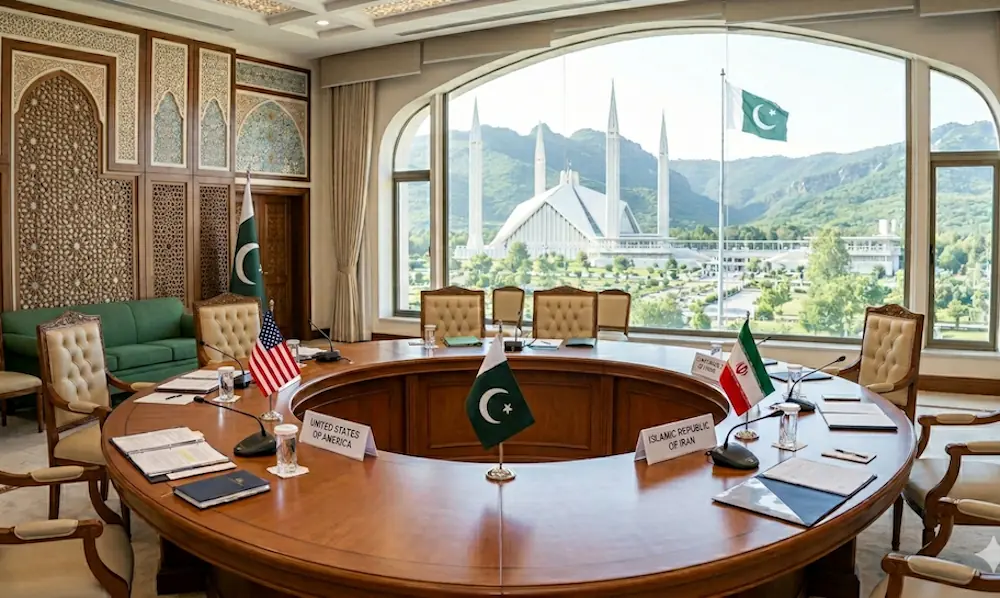

All eyes are on Islamabad this weekend as the city braces to mediate one of the most consequential, high-stakes peace negotiations since the culmination of the Second World War.
Starting today, American emissaries, led by Vice President JD Vance, will sit across the table from Iranian diplomats to negotiate a lasting settlement to a war that has rattled global power structures and stock markets alike.
On the face of it, it is a welcome development from where the world found itself on Tuesday. As daylight drew to a close, the world watched in anticipation as Washington backed itself into an impossible corner, promising to annihilate “a whole civilisation” if Tehran did not give a safe passageway to traffic through the Strait of Hormuz.
But a last-ditch diplomatic breakthrough by Pakistan managed to pull both sides from the brink of a potentially catastrophic escalation of unknowable consequences.
For now, Islamabad seems to have bought both sides some time to turn a fragile truce into something akin to a durable agreement. It is, to put it mildly, a fraught endeavour.
For one, the United States must reckon with the fact that the Iran that sits across the table in Islamabad on Saturday is not the Iran that walked into Geneva in February.
When the US last met Iranian representatives in Switzerland two months ago, the Islamic regime in Tehran was uniquely exposed, perhaps for the first time in its 46-year history. It had barely weathered years of crippling sanctions, a cratered currency, and deafening international isolation. The Twelve Day War had laid bare the vulnerabilities in its ground and air defenses, and had set its nuclear programme back by decades.
The Axis of Resistance, the crown jewel of Iran’s deterrence capability, had been debilitated beyond repair, with supply lines to Lebanon and Gaza severed with the fall of the Assad regime in Syria. And in January, nationwide protests had enfeebled the Ayatollah’s hold on power; the protests were suppressed eventually, but only by the skin of their teeth.
Over the past six weeks, the US and Israel amped up attacks across military installations and civilian infrastructure, expanded targets, and incrementally struck deeper into Iranian mainland, hoping they could batter Tehran into compliance. What they found instead was a country willing to stare the military might of Empire in the face, standing steadfast in its wake, and living to tell the tale.
For all its military bluster, it’s hard to shy away from the fact that the US has remained incapable of translating its wins on the battlefield to achieving its strategic objectives, whatever they may have been. Iran has managed to retain its nuclear infrastructure and enriched uranium stockpiles, thereby securing a compressed timeline to weapons capability should it make the political choice to cross that threshold. More consequentially, however, Tehran has credibly demonstrated its ability to choke global energy flows and hold the world economy hostage, altering the strategic calculus of its adversaries.
In an increasingly globalised world economy, the demonstrated capability to secure and disrupt the flow of commerce is a credible form of political power. According to Professor Robert Pape of the University of Chicago, actors in the international system are able to anticipate disruption, and are forced to adapt in advance, hedging risk and tweaking policy to advance concessions to the party (in this case, Iran) that is generating the risk of disruption. This is a critical shift in the balance of power, which is likely to contort global political response in Tehran’s favor for years to come.
If the core currency of power in international politics is the ability to shape the behaviour of others, it would seem that Iran has skewed the balance of regional power in its favour, and it knows it. Iran’s 10-point proposal, which President Donald Trump has accepted as a “workable” framework upon which the negotiations are to be held, is a statement of what Tehran now believes it’s now entitled to demand.
Calls for enrichment rights, complete sanctions relief, American military withdrawal, and most notably, control over the Strait of Hormuz, point to a country that has recalibrated its sense of its own leverage upward from where it stood less than two months ago in Geneva.
Hence, the US will arrive at the capital militarily undefeated, but it will be Iran that will boast the stronger hand to dictate the terms of peace. It is ultimately this paradox that will loom largest over the mediation process in Islamabad. The outcome of the summit will hinge on Pakistan’s ability to tactfully navigate the twists and turns of this diplomatic quagmire and create a meaningful exit ramp it can credibly package and sell to both sides.
But the White House is no easy sell. For a war that started without a clear strategy or identifiable metric with which to gauge success, the formula for peace is just as murky.
Political patience for America’s excursion into Iran is wearing thin, and the Trump administration has found itself walking a tightrope in trying to hold its political coalition at home. With the midterms slated for November, the administration knows it’s on the clock.
This makes it tough for Washington to read its hand for what it really is. Beyond the blaring war drums and the noise of strikes and counter-strikes, threats and truces, the war has exposed the erosion of something far more fundamental than a kinetic advantage on the battlefield.
For decades, American primacy had anchored itself on one important pillar: the unrivaled ability of the United States to guarantee the stability of critical economic flows. It was this guarantee that underwrote alliances, anchored markets, and ensured American credibility across the world. It was, in a meaningful sense, the infrastructure underlying American power in the world.
In failing to coerce Iran to reopen transit through the Strait of Hormuz, the US has inadvertently cracked the infrastructure wide open, exposing the limitations of its promise. Despite overwhelming conventional military superiority over Iran, allies watched on as the US struggled to unclog one of the most critical energy chokepoints in the world.
The Gulf states were neither consulted before the war nor adequately defended during it. Trump’s continued pressure on NATO has deepened existing fractures in the transatlantic relationship. And Europe, conspicuously, has not responded to American calls for assistance in securing the Strait.
It’s clear that allies are quietly diversifying relationships, and recalibrating their reliance on a security architecture that has suddenly appeared less certain than it once did.
This erosion of credibility will walk alongside the American delegation into the negotiating room, diminishing their leverage to force Iran into accepting a settlement that the Trump administration can sell at home.
What makes this particularly consequential is that the fundamental sticking points have not moved meaningfully. American officials, including Vice President Vance, have sought to revive the push for zero enrichment, a demand Iran has consistently treated as an assault on its sovereignty and its right to technological self-determination. Tehran did not concede that point when it was on its knees in February. It is unlikely to concede it now that it knows it’s negotiating from a position of considerably greater strength.
The result is a zone of possible agreement that is, at best, dangerously narrow. Washington needs an off-ramp it can frame as Iranian capitulation on nuclear ambitions, but lacks the diplomatic maneuverability to actually deliver it. With the US constrained in its diplomatic capital, short on time, and saddled with demands it cannot abandon and Iran will not accept, Pakistani mediators will have a gruelling task ahead of themselves.
Even if Islamabad is able to resolve these seemingly irreconcilable differences, any step towards a lasting settlement will hinge on Washington’s ability to balance its strategic interests with those of the Israelis.
When Netanyahu finally addressed the Israeli public 18 hours after the ceasefire came into effect, his speech was a declaration of unfinished business. “We still have goals to complete,” he told the nation. “We will achieve them either by agreement or by the resumption of fighting.” It was a remarkable thing to say on the first night of a ceasefire — an unambiguous signal to Washington about the limits of Israeli buy-in.
Washington may be foggy on the details of why it went to war, but Jerusalem has had its eye on the ball from the very first day. For Israel, the calculus was as straightforward as it gets: Iran represents the last serious obstacle to an era of unchallenged Israeli regional hegemony in the region, and the window to remove it is closing. American support for Israeli military operations has never been thinner, and Netanyahu, for whom a war with Iran has been the animating obsession of a decades-long political career [Read: ‘What is Netanyahu’s endgame?’], understands that opportunities of this magnitude do not present themselves twice. A negotiated agreement that leaves Iran with any residual enrichment capacity falls categorically short of that objective.
The divergence was clear as soon as the ceasefire took effect. Within hours of Prime Minister Shehbaz Sharif announcing an agreement to pause all hostilities “including Lebanon”, the IDF bombarded Beirut, striking over a hundred targets and killing more than 200 people. Trump was eventually forced to call Netanyahu directly, pressing him to “low-key it” in Lebanon. That a sitting American president had to call his closest regional ally to ask him not to blow up his own ceasefire on its first day is, by any reasonable measure, an extraordinary state of affairs.
This creates a structural fault line underlying the proceedings in Islamabad. Even if an agreement is produced, there will be no real guarantee that Israeli non-compliance will not unravel it. The US will have to answer the overarching question of whether it is negotiating on behalf of itself, or Israel.
The final goals for both have started to diverge.
For Trump, the priority is to reopen the Strait of Hormuz and secure a political win before November. Netanyahu won’t rest until there is a permanent neutralisation of Iran’s power, including its proxies, its missiles, and its nuclear programme. Until Washington resolves which principal it is actually representing at the table, any agreement it reaches will rest on a foundation out of its complete control.
This is not to say that the off-ramp doesn’t exist. But approaching it would require Washington to enter Islamabad with an accurate read of what the past six weeks have produced — a new balance of power in the region.
The US need not surrender its core interests in Islamabad. Within the frameworks that Iran has proposed, the US can still credibly push for a non-weaponisation commitment, verifiable IAEA access, and a durable arrangement to regulate the Strait of Hormuz, wrapping it up in semantics that would register as a win back home.
But achieving this would require the US to stop negotiating toward the deal it wanted before the war and start accepting the deal made possible by the war. The outcome of the peace talks will hinge on whether the parties are able to close the gap between those two positions.
If the talks collapse, the resumption of conflict will arrive in a system where both sides now understand the pressure points better than they did six weeks ago, and where the costs of escalation will be transmitted faster, wider, and further than before.
The ceasefire has revealed a new structure of power, in which the United States can no longer assume control over outcomes through military might alone, and in which even limited disruption via asymmetrical capabilities can reshape the behaviour of the international system.
Islamabad is the first real test of whether diplomacy can operate within the new structure. Whether the parties in that room are up to that task remains to be seen.
Header image created with Generative AI.
if you want to get more information about this news then click on below link
More Detail