-

-
-
Loading
Loading

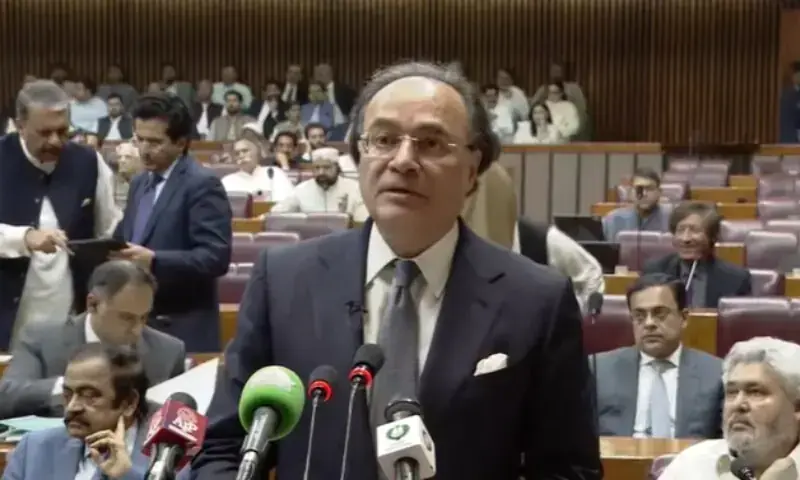

Finance Minister Muhammad Aurangzeb is presenting the FY2026-27 budget in the National Assembly (NA), addressing a session that began two hours after the scheduled time of 3pm and is marred by loud protests by the opposition.
NA Speaker Ayaz Sadiq is presiding over the session, who invited Aurangzeb to present the budget.
The finance minister said the economy was expected to grow four per cent in FY2026-27 and average inflation was expected to be recorded at 8.2pc.
Aurangzeb began by thanking allies part of the ruling coalition, including PPP Chairperson Bilawal-Bhutto Zardari.
He said the budget was being presented at a time when the world listened to Pakistan and desired its friendship. “But this was not coincidental. It began when Pakistan gave a befitting response to India in May 2025.”
“This success was a result of decades-long professional training and preparedness,” he added. “Today, the world praises Pakistan’s defence capabilities. This is the reason that many countries are in contact with Pakistan to include the fighter jets protecting our skies in their fleet.”
The finance minister said the country’s defence sector had become a source of foreign exchange earnings. “It is proof that strong defence is not just important for the country’s sovereignty but could also contribute to economic progress.”
“This defence capability has reshaped our strategic partnerships not just in the region but in the world,” he said, mentioning a defence pact signed between Pakistan and Saudi Arabia last year.
He said last year’s defence pact had laid a new foundation of Pak-Saudi ties, crediting Prime Minister Shehbaz Sharif and Chief of Defence Forces and Chief of Army Staff Field Marshal Asim Munir for it.
The finance minister also elaborated on Pakistan’s efforts for peace between the US and Iran. “Pakistan’s efforts are directed towards establishing long-term peace in the region through an agreement and restoring the transit of oil through the Strait of Hormuz,” he said.
Aurangzeb said Pakistan had “complete support” of China in these efforts, further highlighting the importance of ties between Islamabad and Beijing.
“Pak-China relations are an important part of our foreign policy. China is Pakistan’s most important trading partner,” he said.
Turning his attention to oil prices, he mentioned the US-Israeli war on Iran and noted that petrol and diesel had skyrocketed globally after the conflict.
He said that, however, local prices in Pakistan did not fully reflect this rise in prices. “Had the government passed on the entire burden to the people, the local prices would have been much higher,” he said, saying that the government have given people relief through subsidies of Rs128 billion.
The minister said that the current dispensation, led by PM Shehbaz, would be presenting its third budget.
Before further elaborating on the budget for the upcoming fiscal year, he gave a roundup of the past two years. He said the GDP growth in the outgoing fiscal year was recorded at 3.7 per cent, growth in large scale manufacturing was recorded at 6.1pc and 4.1pc growth was witnessed in the services sector.
“The growth in LSM and services sectors is the highest in four years,” he added.
The minister said the size of the country’s economy had increased to $452bn, terming it a “new milestone”. Moreover, per capita income had increased to $1,901 from last year’s $1,751 and the policy rate had seen a “historic decline” over the past two years, he added.
Aurangzeb further said the country’s foreign exchange reserves had increased to $17bn from $4bn three years ago. “This gives us an import cover for three months.”
He added that remittances had reached $38bn in the first 11 months of the outgoing fiscal year, expressing hope that the figure would exceed $41bn by the end FY26. “It will be the highest in history,” he said.
The minister said the tax-to-GDP ratio had increased to 10.3pc, rising by 2pc over a period of three years. Similarly, fiscal deficit to GDP ratio was expected to reach 4pc from 7.8pc in June 2023, he added.
He said the average inflation was expected to remain around 7pc in the outgoing year, adding that it would reduce with de-escalation between the US and Iran.
Aurangzeb further said the Pakistan Stock Exchange saw a record increase of 173,000 new investors over the past year.
The minister further said that reforms were under way in the Federal Bureau of Revenue, adding that FBR’s annual tax revenue was Rs7,200bn in FY2022-23. This had doubled in three years and was expected to reach Rs13,000bn by the end of this fiscal year, he added.
Moreover, he said the government had introduced loan schemes for small farmers and businesses.
PPP Chairperson Bilawal Bhutto-Zardari is also among the participants.
Earlier, the PPP, the main ally of the ruling PML-N, said its chairperson Bilawal would not attend the session, but it also clarified that the party was not boycotting the session.
“Some members will attend the session. The PPP will be a part of the budget process in the national interest,” the party posted on X.
if you want to get more information about this news then click on below link
More Detail