-

-
-
Loading
Loading

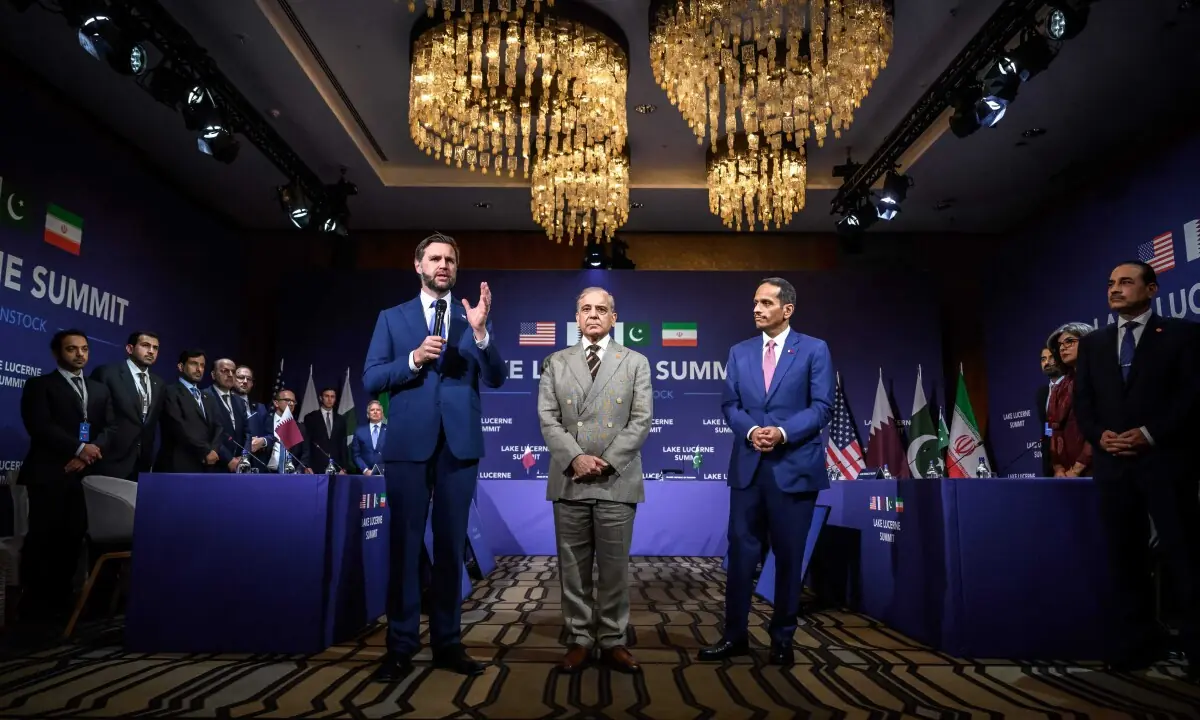

Following months of all-out conflict that began on February 28, 2026, the United States and Iran have transitioned to a de-escalation phase. On June 17, Presidents Donald Trump and Masoud Pezeshkian signed a 14-point memorandum of understanding to end the war, establishing a 60-day ceasefire extension to negotiate the final terms of a deal. Pakistan served as a key mediator throughout the process.
Following the signing and despite a rocky start, the first round of high-level talks concluded in Bürgenstock, Switzerland on Monday, June 22, with the two sides agreeing on a roadmap towards a final deal within 60 days, along with communication lines to keep the Strait of Hormuz open and a deconfliction cell to end fighting in Lebanon.
Mediators Pakistan and Qatar described the outcome as reflecting encouraging progress, with technical talks set to continue through the rest of the week at Bürgenstock. Most observers and experts describe the overall process as a considerable (if still fragile) breakthrough in one of the most complicated conflict-resolution efforts of the 21st century.
However, the emergence of new logic gates of power redistribution, developing within both the shorter (regional) curve and the greater (global) curve, and entangled geopolitically, geo-strategically, and geo-economically across multiple dimensions, risks going unnoticed and undissected. This omission stems from the rupture between the conceptual and strategic power of the parties directly and indirectly involved in the conflict.
War in the Middle East, as a recurring experiment in the geopolitical laboratory, is aimed at providing a new code for the exercise of power at the regional and global levels. No power centre has the capability to act unilaterally to gain a dominant position, nor can any axis of forces undermine the superposition of a single power (that is, the coexistence of several potential power configurations at once). This balance lends the system a degree of power fluidity and a reasonable rate of uncertainty descent before it settles into a new quantum geopolitical state, a newly fixed distribution of power. Under this code of geopolitical behaviour, any party can find itself in a state of wave-particle duality: at once a defined actor and an unresolved set of possibilities.
This means that, as a complex system born at the peak of inter-civilisational collision, this regional conflict cannot be resolved in a linear way, as a parade of endless wars and confrontation on a global scale. The war carries a high risk of returning, and ringing the bells ever harder, until an equilibrium of conceptual and strategic power is reached and wave-particle duality is accepted as the new lens of geostrategic and geopolitical analysis.
if you want to get more information about this news then click on below link
More Detail