-

-
-
Loading
Loading

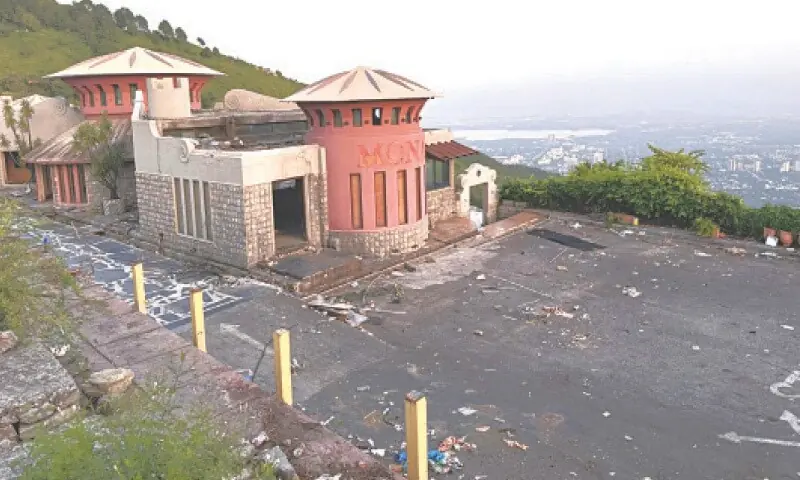

ISLAMABAD: The Federal Constitutional Court (FCC) on Wednesday ruled that earlier Supreme Court (SC) and Islamabad High Court (IHC) decisions that led to the demolition of Monal Restaurant and other commercial establishments within Margalla Hills National Park (MHNP) constituted an exceptional transgression of judicial power, resulting in a “grave miscarriage of justice”.
The SC had ordered the closure of Monal and the adjacent La Montana restaurant on August 21, 2024, and they were closed the next month to protect the park’s biodiversity.
In a short order, a three-member FCC bench headed by Justice Syed Hasan Azhar Rizvi accepted the review petitions filed by the Capital Development Authority (CDA) and the Metropolitan Corporation Islamabad (MCI), challenging the SC’s Aug 21, 2024 directive.
In that order, it was held that any lease, license, allotment, or permission granted for restaurant operations within the protected MHNP was contrary to the Islamabad Wildlife (Protection, Preservation and Management) Ordinance of 1979 and thus had no legal effect.
The judgment eventually paved the way for the closing of Monal, La Montana, and Gloria Jeans restaurants, with their infrastructure subsequently demolished to protect the park’s biodiversity.
The bench — also comprising Justices Aamer Farooq and Syed Arshad Hussain Shah — held that questions relating to the entitlement to or ownership of the restaurant site, its handing over to the Monal Group of Companies by way of lease, and the recovery of rent, etc., involved “disputed questions of fact requiring adjudication by the competent civil court”.
The short order also set aside the SC’s conclusion that any lease, licence, allotment or permission granted by any department or authority, including the CDA, for the operation of restaurants within the park was contrary to the Wildlife Ordinance.
The FCC held that the MHNP formed an integral part of the Islamabad Capital Territory (ICT) and was therefore subject to the laws, rules and regulations applicable to the federal capital. Consequently, the approval of any construction plan or building activity for a public purpose within the MHNP fell within the statutory jurisdiction of the CDA, it emphasised.
Accordingly, the court ruled that the findings of Aug 21, 2024, which stated that the Islamabad Wildlife Management Board (IWMB) was entitled to withdraw rent deposited by the respondent for the preservation, conservation and proper management of the MHNP, and that the board could issue licences to regulate certain activities within the park, were contrary to law and therefore annulled.
As a result, all matters regarding the MHNP’s administration were to be regulated by the CDA strictly in accordance with the applicable law, rules and regulations, the short order said.
The FCC explained that since the 1979 ordinance had been repealed, the Nature Conservation and Wildlife Management Board — constituted under Section 3 of the Islamabad Nature Conservation and Wildlife Management Act, 2024 — was responsible for implementing the act’s provisions. These included ensuring that the construction of rest houses, hotels, and other buildings for the public within the MHNP complies with relevant laws.
The FCC further said the IHC also lost sight of the legal position and rendered a judgment that caused “a grave miscarriage of justice and thus not sustainable in law”.
The court ordered that the concerned civil court would take up suits by consolidating them and proceed from the stage at which they earlier stood.
However, the plaintiffs in those suits, at any appropriate time, would be able to file a fresh application for interim relief regarding subject property to the suits before the trial court. If and when filed, these would be decided in accordance with the law without being influenced by any of the judgments or orders passed by the SC, IHC, District Judge Islamabad or others.
Upon determination of these applications, the civil court will proceed to decide consolidated suits expeditiously on their own merits after providing parties equal, fair and adequate opportunity to produce their respective evidence, the FCC ruled.
In its conclusions, the court said that once the SC judgment was reviewed, every consequential or derivative judgment founded on including the review judgment “cannot survive independently and must also fall”.
The FCC regretted that in the course of deciding interlocutory proceedings arising out of pending civil suits, findings of a final and conclusive nature by the SC were recorded on questions that properly fell within the exclusive domain of the civil court.
Those findings, it said, not only prejudged the disputes pending before the civil court, but also adversely affected the rights and liabilities of “several persons who were neither parties to the proceedings nor afforded an opportunity of being heard” as per the mandate of Article 10-A of the Constitution (the right to a fair trial).
“A judgment affecting the rights of persons who have not been heard cannot ordinarily be permitted to attain finality merely because it has been pronounced by the highest court,” the FCC ruled.
It emphasised that the duty to correct an error was “an obligation cast upon every judge” by the oath taken upon assuming judicial office to preserve, protect and defend the Constitution.
“The power to rectify a manifest wrong does not depend upon the existence of an enabling procedural rule; rather, it inheres in the very function of the court,” the FCC stated. “Whenever an error has occasioned injustice, it is not merely within the court’s authority, but its bounden duty to correct it, for the administration of justice cannot permit a manifest illegality or injustice to endure merely on account of procedural constraints.”
The court noted that “rules of procedure, technicalities, or procedural formalities cannot be permitted to obstruct the administration of justice. Law must bend in aid of justice.”
In its earlier order, the SC had directed that the entrances to the area where the restaurants were established were to be barricaded after which the infrastructure would be demolished, with minimal disturbance to the wildlife and while avoiding damage to the trees of the national park.
Earlier on Sept 10, 2024, the SC had dismissed a similar set of review petitions moved by the Monal Group of Companies, the Capital View Point Restaurant (La Montana), Sunshine Heights (Pvt) Ltd and by Brig (retd) Falak Naz Bangash of the defence ministry.
While rejecting the review petitions, the SC had also declared Monal Group’s Luqman Ali Afzal to be no better than a trespasser, saying that he had no legal right to continue possessing the land at the MHNP.
Likewise, the running of a restaurant by the owner of La Montana and Gloria Jeans was also in total disregard of the provisions of the Islamabad Wildlife Ordinance.
Through its 2024 judgment, the SC had observed that the operators of these restaurants, and those who permitted them to operate, had disregarded the integrity of the national park, ravaged its trees and flora, and displaced and disturbed endemic bird and animal life.
It also stated that the natural environment of the national park had been adversely affected, along with its functions, such as acting as a catchment area for rainfall and facilitating the recharge of springs and streams.
An astronomical environmental cost had also been borne by the public and would continue to be borne by future generations, the SC warned.
if you want to get more information about this news then click on below link
More Detail