-

-
-
Loading
Loading

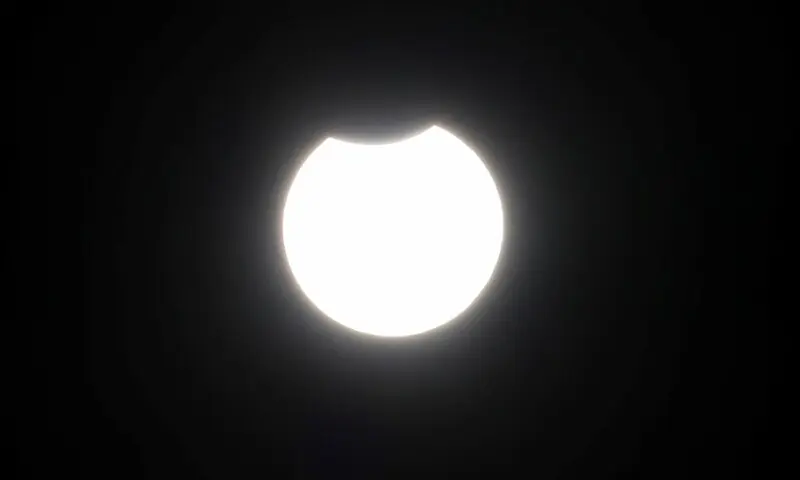

AN Annular (“ring of fire”) solar eclipse marked the first eclipse of the current year on Tuesday, but it was visible for only two per cent of the world’s population.
An annular solar eclipse occurs “when the Moon passes directly between the Earth and the Sun, but the Moon is too far away in its orbit to completely cover the sun’s disc”, Dr Alex Young, associate director at Nasa’s Goddard Space Flight Center in Maryland, said, the CNN reported.
This causes a glowing ring of sunlight surrounding the Moon’s dark silhouette, he added, giving it the name “ring of fire”.
If the Moon completely covers the Sun, it becomes a total eclipse. A partial solar eclipse happens when the Moon passes between the Sun and Earth, but the Sun, Moon, and Earth are not perfectly lined up.
The best view of the ring of fire was from a sliver of Antarctica, with a partial eclipse visible over the rest of the icy continent, as well as in parts of Africa and South America.
Annular solar eclipses happen every one to two years, however many are not visible from most parts of the world. There will be another annular eclipse on Feb 6, 2027, and it will be visible over larger swaths of South America and Africa.
Eclipses come in pairs and occasionally trios. Astronomers call these groups of events eclipse seasons, Young noted, adding that “a solar eclipse is always accompanied by a lunar eclipse about two weeks before or after”.
This annular eclipse marked the first eclipse of the season. A total lunar eclipse will follow on March 3.
Published in Dawn, February 18th, 2026
if you want to get more information about this news then click on below link
More Detail