-

-
-
Loading
Loading

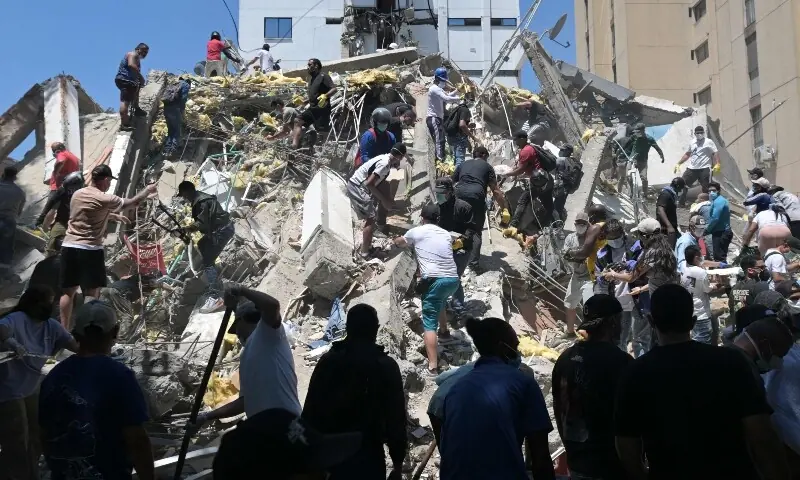

Rescue efforts across western Colombia carried into a second day on Tuesday as emergency workers dug through collapsed buildings and flattened homes, amid expectations that the death toll from the country’s most powerful earthquake in decades could rise.
The 7.4-magnitude earthquake tore through Colombia’s coffee-growing heartland early on Monday, killing at least 164 people.
The quake reduced multi-story buildings to rubble in cities such as Pereira and Cali, and cracked apart one of the towers of a historic cathedral in the city of Manizales.
Emergency teams aided by police, soldiers and volunteers worked through the night with excavators and, at times, their bare hands, hunting for survivors beneath debris.
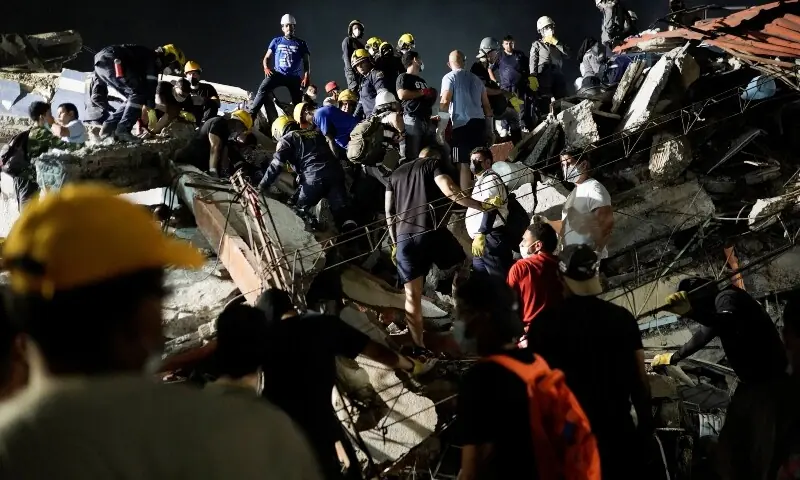
In Cali, home to about 2.2 million people, at least 85 people were killed. Dozens of buildings were left leaning precariously or destroyed outright, forcing residents into the streets.
Several of the top floors of one of the city’s hospitals — some dedicated to pediatric care — collapsed upon themselves, leaving some patients trapped and forcing some 600 others to be tended to on a street strewn with rubble, hospital director Irne Torres Castro told Caracol television.
Carmen Yasmin Garcia, 43, a Cali resident volunteering with rescue teams, said on Monday afternoon that her group had freed seven people from a collapsed building, but four others and a dog remained trapped.
“A moment ago there was scratching, but now we can’t hear anything; we still have faith that the dog is alive and we can get these people out,” Garcia said.
“We need people with sticks and spades, the more people lending a hand the better.”
In Pereira, capital of the hard-hit state of Risaralda, authorities reported 66 dead.
The city also bore some of the most visible destruction, with entire residential blocks reduced to piles of concrete and twisted steel.
Video posted on social media and verified by Reuters showed the city’s airport violently swaying during the quake, with large chunks of the ceiling collapsing as people sheltered.
Another 13 people died in Choco, the rural province closest to the quake’s epicenter.
President Abelardo De La Espriella, who assumed power just days ago, said 35 people died in Cali alone, while 188 were missing. He said 1,000 members of the security forces would be deployed to the city by dawn, following reports of looting.
Cali, as well as Pereira, implemented curfews on Monday night.
“Our intention is to cooperate in any way necessary. Here, there are no distinctions or ideological divisions when it comes to defending our people or showing solidarity,” De La Espriella told journalists on Monday evening.
The disaster has drawn comparisons to a deadly 1999 earthquake that devastated the same coffee-growing region, killing more than 1,000 people, as well as to catastrophic quakes that killed more than 6,300 in neighboring Venezuela in June.
European Union foreign policy chief Kaja Kallas said on Tuesday the EU was providing funding to support the rescue efforts.
“The EU has mobilised Copernicus, our satellite service, to support rescue and relief operations. We are providing funding to support the response, including through the Red Cross,” Kallas posted on X.
“We have also activated the EU’s crisis consular assistance mechanism to support EU citizens caught in the disaster,” she said.
Meanwhile, Prime Minister Shehbaz Sharif also expressed deep grief over the loss of lives and widespread devastation in Colombia.
“Deeply saddened by the tragic loss of lives and widespread devastation caused by the powerful earthquake in Colombia. On behalf of the people and government of Pakistan, I extend my heartfelt condolences to President Abelardo De La Espriella, the people of Colombia, and all the families who have lost their loved ones.
“Our thoughts and prayers are with the injured and all those affected by this tragedy. Pakistan stands in solidarity with the people of Colombia in this difficult hour,” he wrote on X.
if you want to get more information about this news then click on below link
More Detail