-

-
-
Loading
Loading


WASHINTON: Between the steady drumbeat of military escalation and the fragile stirrings of diplomacy, Pakistan has positioned itself as a rare and consequential channel of engagement in a crisis that threatens to widen into a full-scale regional war.
By late Monday, speculation in the US capital had shifted toward the possibility of American ground operations in Iran. The shift followed President Donald Trump’s interview with the Financial Times, in which he spoke of “taking the oil” in Iran — remarks widely interpreted here as referring to the possible seizure of Kharg Island, Tehran’s principal crude export hub that also houses a naval facility.
“To be honest with you, my favourite thing is to take the oil in Iran,” Trump told the newspaper. He added that Iran had agreed to “most of” a 15-point US proposal conveyed through intermediaries.
The rhetoric coincided with mounting reports of military preparations.
The Washington Post reported that the Pentagon is preparing for weeks of potential ground operations, as thousands of American soldiers and Marines move into the Middle East for what officials described as a possible “dangerous new phase” should the president decide to escalate.
According to the newspaper, any ground action would likely stop short of a full-scale invasion but could involve raids carried out by Special Operations forces alongside conventional infantry units.
The New York Times reported separately that US Special Operations commandos have been deployed to the region while Trump weighs options.
The paper noted that these forces could be used to safeguard shipping lanes in the Strait of Hormuz, participate in a mission to seize Kharg Island, or target sites linked to Iran’s enriched uranium programme.
Elements of the 82nd Airborne Division are reportedly on the move, alongside Marines trained in amphibious landings. Officials acknowledge that any such operation would expose US personnel to Iranian drones, missile fire and irregular ground attacks.
Tehran’s rhetoric has been equally forceful.
Mohammad Bagher Ghalibaf, the speaker of Iran’s parliament and a former Revolutionary Guard commander, warned that Iranian forces were “waiting for the arrival of American troops on the ground to set them on fire,” according to state media reports.
Iranian officials have also dismissed diplomatic overtures as possible cover for military escalation, underscoring deep mistrust.
Yet even as military contingency planning intensifies, diplomatic channels remain active.
Speaking to reporters aboard Air Force One, President Trump insisted that Iran had responded positively to most US demands. “They’re agreeing with us on the plan,” he said. Iranian sources, however, have indicated that any pause in the month-long conflict would require an immediate halt to strikes and guarantees against renewed attacks.
It is within this narrow diplomatic opening that Pakistan has stepped forward.
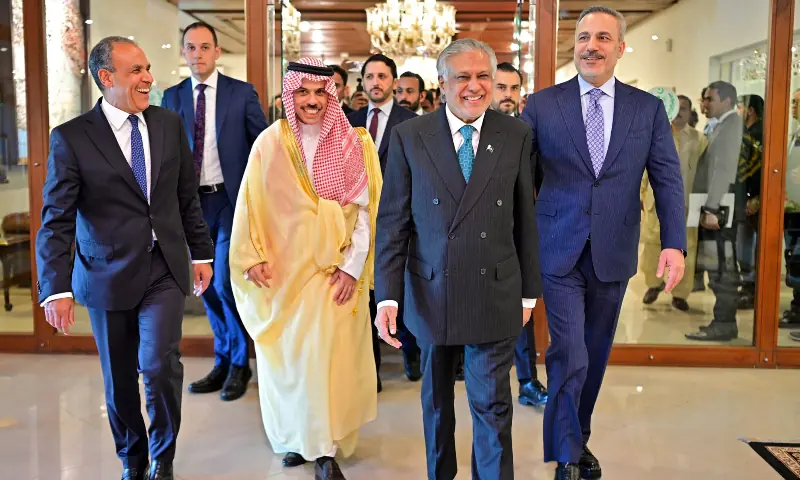
On Sunday, Islamabad hosted foreign ministers from Saudi Arabia, Egypt and Turkey in consultations aimed at de-escalation.
Prime Minister Shehbaz Sharif has spoken with Iranian President Masoud Pezeshkian, emphasising restraint and a return to dialogue.
Pakistani officials have publicly indicated that Islamabad stands ready to host and facilitate US–Iran talks, whether direct or indirect.
In Washington’s policy community, that offer has drawn measured but notable attention.
Michael Kugelman, Director of the South Asia Institute at the Wilson Center, described Pakistan’s willingness to facilitate talks as “the most promising development to date” in efforts to end the war.
He argued that Pakistan’s mediation role — particularly as a US–Iran go-between — makes strategic sense at a time when direct engagement remains politically constrained for both Washington and Tehran.
Islamabad, he noted, maintains working ties with both capitals and has historically served as a discreet diplomatic channel in sensitive situations.
Even if mediation ultimately falls short, Kugelman suggested, Pakistan’s effort would still advance its strategic interests by reinforcing its diplomatic relevance during a period of heightened regional instability.
A similar assessment came from Lisa Curtis, who served as deputy assistant to the US president and senior director for South and Central Asia at the National Security Council from 2017 to 2021 and is currently a senior fellow at the Center for a New American Security.
“It may be surprising to some that Pakistan has taken on the risky role of a key mediator between the United States and Iran,” she observed.
“However, if successful, Pakistan would burnish its diplomatic credentials and receive a major boost to its relations with the United States.”
Her comments reflect a broader recognition in Washington that Pakistan’s mediation effort builds on a gradual improvement in bilateral ties over the past year. A successful diplomatic intervention — or even a stabilising ceasefire — could further consolidate that trend.
At the same time, domestic debate in the United States is sharpening. Senator Rand Paul, a Republican from Kentucky and chairman of the Senate Homeland Security Committee, has questioned the legality of launching military action without congressional approval.
He warned that prolonged conflict could carry constitutional and political consequences, particularly if the administration seeks additional funding for military operations.
The war has already inflicted thousands of casualties and disrupted maritime traffic near the Strait of Hormuz, a critical artery for global energy supplies.
US lawmakers, scholars and media outlets warn that any move to seize territory such as Kharg Island or conduct sustained ground raids inside Iran would mark a dramatic escalation, potentially drawing additional regional actors into the conflict.
Some described the present moment as a stark duality. On one side stand airborne brigades, amphibious assault units and Pentagon contingency plans. On the other stands a diplomatic initiative centred in Islamabad seeking to transform indirect exchanges into structured dialogue.
They argued that wars often gather momentum quickly; de-escalation requires restraint, political will and credible intermediaries.
Between escalation and engagement, Pakistan has chosen to invest its diplomatic capital in the harder path.
Whether that effort succeeds will depend largely on decisions taken in Washington and Tehran in the coming days. But for now, Islamabad’s initiative remains one of the few tangible indications that diplomacy has not been eclipsed by the logic of force.
if you want to get more information about this news then click on below link
More Detail