-

-
-
Loading
Loading

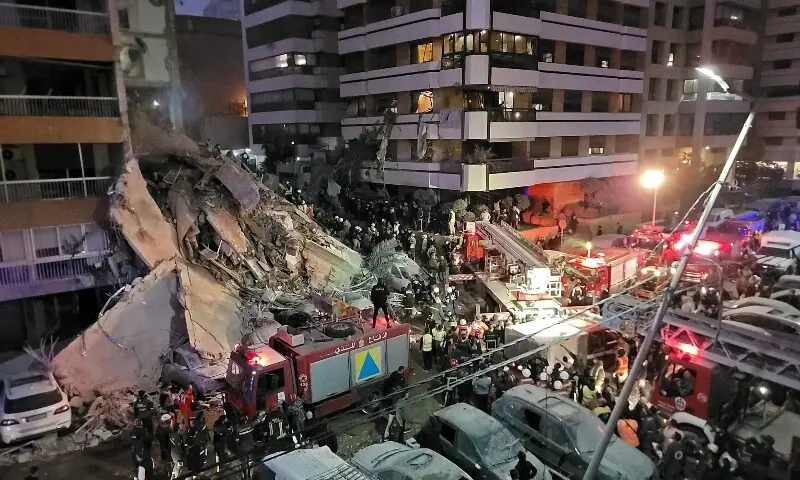

Israel carried out its heaviest strikes on Lebanon since the conflict with Hezbollah broke out last month, even as the Iran-aligned group paused attacks on northern Israel and Israeli troops in Lebanon under a two-week US-Iran ceasefire.
Consecutive explosions shook Beirut, sending smoke billowing across the capital, as Israel’s military said it had launched the largest coordinated strike of the war.
More than 100 Hezbollah command centres and military sites were targeted in Beirut, the Bekaa Valley and southern Lebanon, it said.
The strikes killed 112 people and wounded 837 across the country, Lebanon’s health ministry said.
In Beirut, Reuters reporters saw people on motorcycles picking up wounded and transporting them to hospitals because there were not enough ambulances to get them in time.
A group of firefighters worked to put out flames in a car park after one strike left more than a dozen cars scorched and mangled.
The head of Lebanon’s syndicate of doctors, Elias Chlela, called in a written statement for “all physicians from all specialities” to head to any hospital they could to offer help. One of Beirut’s biggest hospitals said it was in need of donations of all blood types.
Israeli Prime Minister Benjamin Netanyahu insisted overnight that the ceasefire suspending the six-week-old US-Israeli war on Iran did not apply to Lebanon, and the Israeli military said operations against Hezbollah there would continue.
That position contradicted comments by Prime Minister Shehbaz Sharif, who had said the truce would include Lebanon.
White House Press Secretary Karoline Leavitt also said during a press briefing that Lebanon was “not part of the ceasefire” between the US and Iran, echoing earlier remarks attributed to US President Donald Trump by media outlet PBS.
“As you know, Prime Minister Netanyahu put out a statement last night in support of the ceasefire, in support of the United States’ efforts and has also assured the president that they’ll continue to be a helpful partner throughout the course of the next two weeks,” Leavitt added.
Asked if Lebanon would be included at a future date, Leavitt replied that the matter would continue to be discussed by all parties, but “at this point in time, they are not included”.
For his part, Iranian Foreign Minister Abbas Araghchi said in a post on X that the terms of the ceasefire were “clear and explicit”, adding that the US must choose between a ceasefire or continued war with Israel and “it cannot have both”.
“The world sees the massacres in Lebanon. The ball is in the US court, and the world is watching whether it will act on its commitments.”
In a statement, Hezbollah condemned what it called Israel’s “barbaric aggression” and said the attacks underscored its “natural and legal right to resist the occupation and respond to its aggression.”
Iran’s Revolutionary Guards warned the US and Israel that it would deliver a “regret-inducing response” if attacks on Lebanon did not stop.
Israel had also carried out strikes across southern Lebanon earlier in the day, including artillery shelling and a dawn airstrike on a building near a hospital that killed four people, Lebanon’s state news agency NNA reported.
A strike on the southern city of Sidon killed eight people and wounded 22 others, Lebanon’s health ministry said.
A further strike hit central Beirut in the early evening, NNA reported.
The Israeli military said it attacked a Hezbollah commander in Beirut, without providing further details.
Hezbollah stopped attacking Israeli targets early on Wednesday, three Lebanese sources close to the group told Reuters.
The group’s last public statement on its military activity was posted at 1am local time, saying it had targeted Israeli troops inside Lebanon on Tuesday evening.
“Hezbollah was informed that it is part of the ceasefire so we abided by it, but Israel as usual, has violated it and committed massacres all across Lebanon,” senior Hezbollah lawmaker Ibrahim al-Moussawi told Reuters.
Another Hezbollah lawmaker, Hassan Fadlallah, told Reuters the Israeli strikes were “a grave violation of the ceasefire” and that there would be “repercussions for the entire agreement” if they continued.
Lebanese President Joseph Aoun said Beirut would continue its efforts to ensure that Lebanon was included in any lasting regional peace agreement.
Most of Wednesday’s strikes were in civilian-populated areas, Israel’s military said.
Hours before the strikes, the military had issued warnings for some areas of southern Beirut and southern Lebanon. No such warning was given for central Beirut, which was also hit.
Following the strikes, Israeli military spokesperson Avichay Adraee said on X that Hezbollah had moved out of its stronghold in southern Beirut’s Dahiyeh neighbourhood to religiously mixed areas of the city, including in the north.
Addressing Hezbollah, he said, Israel’s military will “pursue you and act with great force against you wherever you are”.
In a western neighbourhood of Beirut that was hit by a strike, Naim Chebbo, 51, swept up shards of glass that had been blown out of the window frames by the force of the blast.
“Tonight I’m not going to sleep because I’m going to be afraid that it’s happening again. I’m living a nightmare,” he told Reuters.
More than 1,500 people have been killed in Israel’s air and ground campaign across Lebanon, including more than 130 children and more than 100 women, since March 2, when Hezbollah started firing rockets at Israel in solidarity with Tehran.
Israel has issued evacuation orders covering around 15 per cent of Lebanese territory since then, mostly in the south and in suburbs south of Beirut.
More than 1.2 million people have been displaced, according to Lebanese authorities.
Israel has also pledged to occupy southern Lebanon up to the Litani River as part of a “security zone” it says is intended to protect its northern residents.
“Hopefully, a ceasefire will be reached,” said Ahmed Harm, a 54-year-old man displaced from Beirut’s southern suburbs.
“Lebanon can’t take it anymore. The country is collapsing economically, and everything is collapsing.”
Outside a school sheltering displaced people in Sidon, pillows and blankets were piled onto cars as some families held out hope of returning home soon.
“We’re just waiting for the official decision from the top, so we can go back,” said Samar al-Saibany, one of the displaced.
Local mayor Mustafa al-Zein said more than 28,000 people were sheltering in the area as of Tuesday night.
if you want to get more information about this news then click on below link
More Detail