-

-
-
Loading
Loading
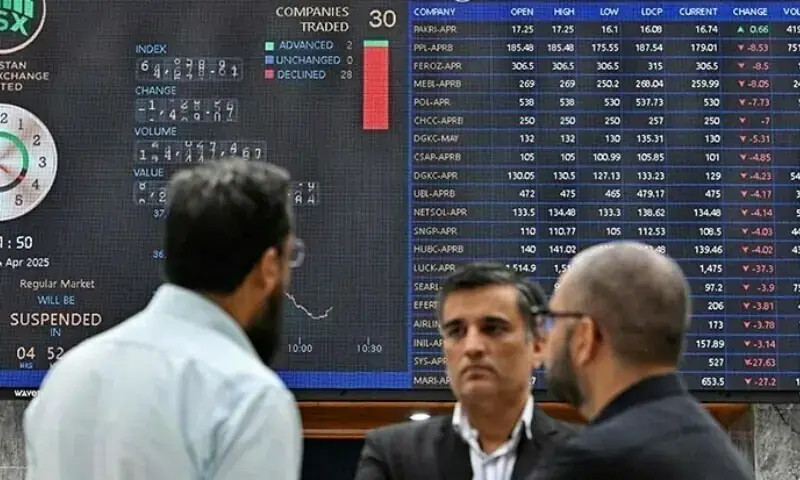

KARACHI: The Pakistan Stock Exchange (PSX) extended its recovery for a second consecutive week, buoyed by easing geopolitical tensions in the Middle East and expectations of a softer monetary policy as declining oil prices temper inflationary pressures.
The benchmark KSE-100 index rose 4 per cent week-on-week to close at 173,939 points, gaining 6,748 points, according to Arif Habib Ltd (AHL).
Though the index during the week surpassed its pre-war level of 168,062, recorded on Feb 27, highlighting a robust recovery in market sentiment. However, despite the surge, the index remains around 15,227 points below its all-time high of 189,166.83 points recorded on Jan 23.
Investor sentiment improved on reports suggesting progress towards a potential understanding between the United States and Iran, with expectations of further talks, as Tehran announced it has opened the Strait of Hormuz to all traffic during the ceasefire.
Market participants also anticipated a status quo or marginal cut in the State Bank of Pakistan’s policy rate at the upcoming Monetary Policy Committee meeting on April 27, lending additional support to equities.
Topline Securities said optimism surrounding geopolitical stability and softer oil prices attracted renewed buying interest. Trading activity strengthened, with the average daily volume rising 37.6pc week-on-week to 1.2 billion shares, while average traded value increased 17pc to Rs48 billion.
On the macroeconomic front, Pakistan posted a current account surplus of $1.07bn in March, up from $231m in February, indicating a notable improvement in external balances. However, net foreign direct investment stood at $168m in March, down from $214m in February.
Automobile sales, as reported by the Pakistan Automotive Manufacturers Association, rose 40pc year-on-year to 15,531 units in March, though declined 9pc on a month-on-month basis.
AHL noted that the market’s upward momentum was supported by continued optimism following a temporary ceasefire and expectations of further diplomatic progress. A 10-day ceasefire in Lebanon also contributed to improved sentiment.
Economic indicators remained broadly supportive. Large-scale manufacturing output grew 6.5pc year-on-year in February, although it declined 9pc month-on-month. On a cumulative basis, output increased 5.9pc over eight months of FY26.
In the banking sector, deposits rose 18.6pc year-on-year to Rs37.5 trillion in March, while advances increased 8.1pc and investments surged 20.8pc.
Power generation rose 6pc year-on-year to 8,939 gigawatt-hours in March, driven by stronger demand and a favourable energy mix. Generation costs declined 15pc to Rs8.08 per kilowatt-hour, keeping fuel cost adjustments low.
Information technology exports increased 20pc year-on-year to $413m, accounting for 46pc of total services exports.
Meanwhile, Oil and Gas Development Company Ltd announced a major discovery at the Baragzai X-01 well in the Nashpa block, with significant additions to oil, gas and liquefied petroleum gas output.
Pakistan’s sovereign rating was reaffirmed at ‘B-’ with a stable outlook by Fitch, while the rupee remained largely stable, appreciating to a three-year high of Rs278.92 against the dollar.
However, State Bank reserves declined by $1.3bn to $15.08bn during the week, mainly due to external debt obligations, including Eurobond, which matured on April 8.
AKD Securities said market momentum remained positive, supported by easing geopolitical risks, softer oil prices and inflows from Saudi Arabia. Sentiment was further aided by the government’s announcement of fuel price cuts.
Flow-wise, individuals and local companies emerged as net buyers, purchasing equities worth $8.4m and $7.4m, respectively. In contrast, banks, foreign corporates and insurance companies were net sellers, offloading shares worth $15.4m, $9.4m and $5.4m.
Sector-wise, fertiliser and automobile stocks remained in focus. Urea offtake surged 86pc year-on-year in March, while other fertiliser segments also posted gains. Auto sales growth was driven primarily by strong tractor demand.
Among listed companies, United Bank Ltd’s stronger-than-expected first-quarter earnings contributed significantly to index gains.
Looking ahead, analysts expect the market to remain sensitive to developments in US-Iran talks and the corporate earnings season. The benchmark index is currently trading at an 8.5x price-to-earnings multiple, offering a dividend yield of around 6pc.
AKD Securities maintained that valuations remain attractive, projecting the KSE-100 index could reach 263,800 points by December, contingent on sustained macroeconomic stability and favourable external developments.
Published in Dawn, April 19th, 2026
if you want to get more information about this news then click on below link
More Detail