-

-
-
Loading
Loading

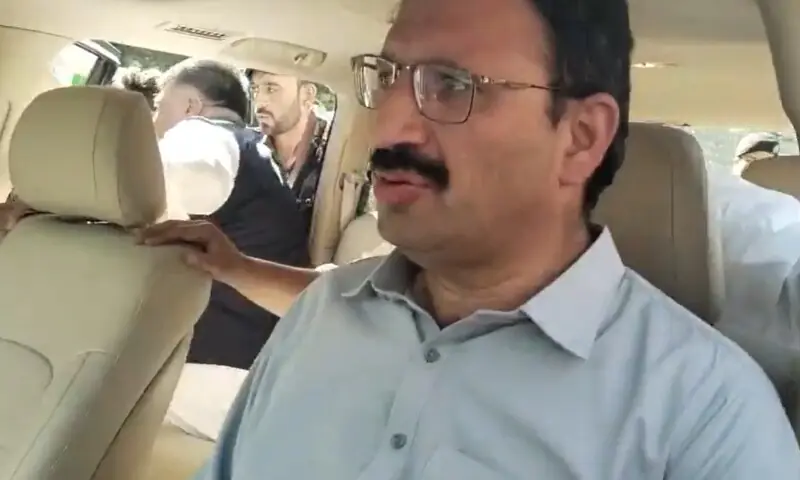

The PTI alleged that its president in Khyber Pakhtunkhwa, MNA Junaid Akbar was “arrested” in Gilgit-Baltistan on Friday while campaigning for upcoming elections and later expelled from there.
Initially the PTI claimed in a post on X that “PTI KP President Junaid Akbar, along with MNAs Saleemur Rehman, Amjab Ali Khan, Syed Mehboob Shah, MPA Naeem and […] Dr Nawaz were arrested by the GB government and administration at a check post when they were returning from the Ghizer district”.
The party further alleged that the party leaders had been “taken to Gilgit”.
The PTI also shared a video the alleged arrest on X, in which Akbar and others were seen sitting inside what appeared to be a van. In the background, a man in a police uniform could also be seen.
Akbar earlier posted on X that the PTI workers and supporters had reached Ghizer to hold a rally ahead of June 7 general elections in GB.
In another post, he alleged that he and his companions were first stopped while they were travelling to Ghizer. He said the district administration told them that they lacked a “permit”.
“Isn’t Gilgit-Baltistan a part of Pakistan? Why does a Pakistani need a no-objection certificate (NOC) to travel within their own country?” he questioned.
“Fascist tactics and panic are a clear declaration of their defeat. If they lack the courage to compete in the field, then why stage this election drama? This open violation of constitutional rights and fascism will not be accepted under any circumstances,” he said.
In a subsequent post, he added, “I was told to leave Gilgit as I don’t have an NOC, and now I have been stopped at the checkpost again. Is Gilgit-Baltistan not a part of Pakistan?”
Later, Akbar, as well as the PTI posted on X that he had been “expelled” from GB.
He also accused to the federal government in another post of employing tactics to “steal the election”.
“Our party’s symbol has been snatched from us, we’re not allowed to run election campaigns but are instead arrested … We were stopped in Gilgit, arrested, and expelled from the province, while PML-N leaders are provided VIP protocol and full security,” the post stated.
The PTI termed the “arrest and expulsion” of Akbar during election campaign “political revenge, pre-poll rigging and an attack on democracy”.
The party demanded a level-playing field for all parties and a fair and transparent election in GB.
Prior to the reports of Akbar’s expulsion, former National Assembly opposition leader Omar Ayub condemned his alleged arrest on X.
“Strongly condemn the arrest of PTI provincial president KPK Junaid Akbar Khan in Hunza, Gilgit-Baltistan. This action proves that the Form 47 installed regime wants a bogus ‘selection’ instead of a free and fair election,” he wrote.
KP Chief Minister Sohail Afridi warned in a post on X that if the parliamentarians were not released, “I will personally go there to question the puppet GB government and those working to install a fake government about the mistreatment of our parliamentarians”.
He added that such acts were “harming Pakistan”.
“Such behaviour is increasing hatred, and such steps are creating divisions. Those whose job is to protect the public mandate always rob the Pakistanis of their mandate.
“By not providing a level playing field in the elections and by forcibly, through oppression and coercion, [excluding] Imran Khan sahib’s party, the democratic system is being destroyed,” he claimed.
He also claimed that the GB chief minister was not responding to his calls.
“This attitude is undemocratic and not political. We will not let GB turn into a no-go area,” he said, adding that the “hospitable” people of GB would avenge this dishonour of their guests through their votes.
This is a developing story that is being updated as the situation evolves. Initial reports in the media can sometimes be inaccurate. We will strive to ensure timeliness and accuracy by relying on credible sources, such as concerned, qualified authorities and our staff reporters.
اگر آپ اس خبر کے بارے میں مزید معلومات حاصل کرنا چاہتے ہیں تو نیچے دیے گئے لنک پر کلک کریں۔
مزید تفصیل